The Alabama Department of Commerce is seeking applicants for Film Office Director.
$85,000 – $153,000
Location:
Department of Commerce
401 Adams Avenue Suite 625
Montgomery, Alabama 36108[334] 242-0445
APPLICATION DEADLINE : July 15, 2024
PROJECTED START DATE: September 1, 2024
The objective of the Alabama Film Office is to promote the State of Alabama as a location site for entertainment productions. This work is performed under general direction of the Secretary of Commerce. The Alabama Film Office Director handles administrative and management work in the planning, directing, coordinating, and promoting of the state for film, television, video, video games, and music entertainment.
DUTIES AND RESPONSIBILITIES:
- Manage and supervise film office personnel in accordance with established policies, and procedures.
- Communicate with production companies regarding inquiries related to polices of the entertainment incentive program. Provide detailed guidance pertaining to application procedures, along with the rules, regulations, and policy impact on each specific project.
- Provide leadership and direction to move film projects through the recruitment process to ensure the proper state agencies or local contacts are engaged at the appropriate time.
- Interpret entertainment industry requests relating to scripts, documentaries, commercials, and videos, etc. to effectively recommend Alabama sites that meet specific architectural, geographical and/or technical requirements for the producers in the requested time frame.
- Negotiate with interested production companies in locating to Alabama and qualifying for the entertainment incentives. Work with local municipal film offices to recommend location filming specific to production needs.
- Develop and maintain relationships with industry professionals. Follow-up with contacts to keep up with on-going projects and learn of potential production leads.
- Maintain film project files so to ensure the documentation of project developments, followups, and projected deadlines are met timely and accurately.
- Create and coordinate the Alabama Entertainment Advisory Board under the direction and advisement of the Secretary of Commerce. Duties include maintaining the Board member roster and contact information; periodically calling meetings as needed or as requested by the Secretary of Commerce; planning location, itinerary, and meeting topics for discussions; and maintaining Board meetings minutes to be made available to Board members.
- Provide insight, evaluate and/or develop a competitive entertainment incentive program to attract the film and entertainment industry to expand the state of Alabama economic development.
- Performed other duties as necessary within scope of classification by the Secretary of Commerce.
Work Habits:
- Comply with all policies and procedures as set by the Departments of Personnel and Commerce.
- Plan daily/weekly work schedule.
- Maintain housekeeping to organizational standards.
- Interact professionally with co-workers, general public, and others as required.
- Comply with the Department of Commerce policy regarding attendance. (Regular and predictable attendance is an essential function of the job.)
Required Knowledge, Skills, and Abilities:
- Knowledge of the Alabama Entertainment Incentives, along with the application approval process, and audit filing to receive the incentives rebate.
- Knowledge of film industry production and business relations; film and television terminology and techniques.
- Knowledge and ability to oversee management of the agency’s film industry (Reelscout) database.
- Knowledge and understanding of state government executive and legislative branches:
– Ability to coordinate with other state departments and outside agencies.
– Ability to develop budget recommendations.
– Ability to communicate effectively, establish and maintain effective working relationships with public officials state legislators, department heads, multimedia, agencies, civic groups, and the general public.
Required Minimum Qualifications:
A bachelor’s degree or higher from a recognized college or university in liberal arts, business administration, marketing or a closely related field, and a minimum of three years responsible administrative experience in public relations, travel, tourism, or the film industry; or a combination of education and experience equivalent to these requirements.
Salary:
Salary will be based on experience within a range of $85,000 – $153,000 annually.
Benefits:
Excellent benefits package included. Employees are offered a competitive benefits package which includes health and dental insurance, paid annual and sick leave, paid holidays, and a retirement program.
Apply:
Resumes may be accepted via U.S. Postal Mail, Electronic Mail, and/or faxed to:
ATTN: STEPHANIE McMEANS
DEPARTMENT OF COMMERCE HUMAN RESOURCE MANAGER
401 Adams Avenue, Suite 624
Montgomery, Alabama 36130-4106
FAX: 334-353-1212
EMAIL: [email protected]
Resumes received after 5:00 p.m. on July 15, 2024, will not be considered for review.
Interviews are by appointment only. If selected for an interview, applicants must travel at their own expense to the interview site. Employment references may be requested during the application process.
The Department of Commerce/AIDT is an equal opportunity employer. It is the official policy of the Department of Commerce/AIDT that no person shall, on the grounds of race, color, disability, gender, religion, creed, national origin, or age, be excluded from participation in, be denied the benefits of, or be subjected to discrimination under any program, activity, or employment. The Department of Commerce/AIDT will make reasonable accommodations for qualified applicants or employees with disabilities. The Department of Commerce/AIDT reserves the rights to withdraw, modify, or extend this job announcement at any time prior to the awarding of the position. The Department of Commerce/AIDT participates in E-Verify, a federal law that requires all employers to verify the identity and employment eligibility of all persons hired to work in the United States.
State Superintendent of Education Dr. Eric Mackey shared good news about public education during the April 11, 2024, meeting of the State Board of Education. Alabama high schools graduated more students in the spring of 2023, compared to 2022, and, equally important, more of them are ready for the next steps in their lives.
Being College and Career Ready (CCR) took on additional significance in 2023 when the Alabama Legislature passed Act 2023-365, which changed the date established by a State Board of Education rule requiring all high school students, beginning with the Class of 2028, to earn at least one college and career readiness indicator prior to graduation. The State Board’s graduating Class of 2028 became the Alabama Legislature’s Class of 2026; it is now the law of the land, and it was a good act.
However, as these changes to graduation requirements were unfolding, there was no funding appropriated to help high schools, especially those with low CCR rates to implement a plan to meet the 2026 deadline. Working with Governor Ivey and her team, leaders in business and industry, Dr. Eric Mackey, key legislators, and other supportive groups recommended a $25 million appropriation, and the legislature agreed.
The Fiscal Year (FY) 2024 Education Trust Fund (ETF) Budget included $15 million for college and career readiness grants, and the FY 2024 Education Trust Fund Supplemental Budget included $10 million for college and career readiness grants. The Fiscal Year 2025 Education Trust Fund (ETF) Supplemental Budget includes $17 million for college and career readiness grants.
It is great news that the high school graduation rate and the college and career readiness rate are trending higher. Due to the investments made last year, as well as the sense of urgency created by the State Board of Education and the Legislature, the gap between the graduation rate and the college and career readiness rate was closed by 3.2 percentage points in one year and by 10 percentage points in two years. This is significant, considering the gap was 16 percentage points as recently as 2021. However, the work is not done, as there remains a 6-percentage point gap between the graduation rate of 90 percent and the college and career readiness rate of 84 percent for the Class of 2023.
This is why targeted funding matters. Governor Ivey’s Commission on Teaching and Learning recommended that for every high school to be ready to meet the 2026 college and career readiness requirement, the full $25 million be continued annually “with a priority given to high school with the greatest implementation challenges.” In other words, target more funding per pupil to the high schools that are the farthest away from reaching the college and career readiness graduation requirement.
The Alabama Legislature acted wisely in 2023 when it codified the college and career readiness graduation requirement and moved the implementation date forward from 2028 to 2026. Governor Ivey, the State Superintendent of Education, and the State Board acted wisely by requesting $25 million for FY2024 and the results are encouraging. The Legislature can continue the positive trend by providing the full appropriation of $25 million annually for the potentially game-changing college and career readiness grants. Moving forward, the Legislature should consider implementing a weighted student funding formula that prioritizes funding for schools with the greatest challenges and student needs.
By Joe Morton, PhD, President, Business Education Alliance of Alabama; Chairman, Governor Ivey’s Commission on Teaching and Learning; and Former State Superintendent of Education (2004-2011)
# # #
 Joseph B. Morton – Chairman and President
Dr. Morton was selected by the Alabama State Board of Education to be Alabama’s 36th State Superintendent of Education on July 13, 2004. He served in this capacity for seven years. Prior to the appointment as State Superintendent of Education, Dr. Morton served for eight years as Deputy State Superintendent of Education. Dr. Morton has a B.S. degree from Auburn University and M.S. and Ph.D. degrees from The University of Alabama.
As Deputy and State Superintendent of Education Dr. Morton guided the creation and implementation of the Alabama Reading Initiative; the Alabama Math, Science, and Technology Initiative; the Alabama Connecting Classrooms, Educators, and Students Statewide (Distance Education) Initiative; and FIRST CHOICE (a new graduation plan for Alabama’s students). While serving as State Superintendent of Education, Alabama showed significant academic gains in reading and math assessment scores and was judged a national leader in training future teachers and principals. Alabama is considered a national leader in student nutrition.
In 2008 Dr. Morton was given a national award by the State Educational Technology Directors Association (SETDA): the “State Policymaker Award.” In 2010 Alabama had the largest gain in the nation in Advanced Placement enrollments and students scoring 3-5 on AP exams and had the third highest gain in the nation on increasing the high school graduation rate.
The Alabama Office of Apprenticeship and FuelAL, a program under the Economic Development Partnership of Alabama (EDPA), are pleased to announce their partnership in hosting the Third Annual Alabama Summit on Talent Retention & Work-Based Learning. Set to occur at Regions Park in Birmingham, Alabama, from April 8th to 10th, the Summit aims to convene employers, educators, economic developers, and workforce professionals from across the state to explore best practices in talent retention and workforce development.
Building on the breakout success of the 2023 conference, this gathering will feature speakers and panelists from various sectors, offering unique perspectives on how talent retention and work-based learning initiatives can contribute to a thriving economy. Attendees can expect a range of breakout sessions and panels addressing key topics such as apprenticeship programs, career pathways, and other resources for work-based learning. The summit promises to equip participants with valuable tools and resources for effective workforce development.
“To keep Alabama’s top talent in the state, it is essential we understand how to give what bright, young professionals really want,” stated Miller Girvin, Executive Vice President of Innovation & Talent at EDPA. “This Summit offers an opportunity for those who can make a huge difference in this space – employers, career-development offices and community leaders – to share best practices and learn how to showcase the promising careers and lifestyles that Alabama can deliver.”
Director Josh Laney of the Alabama Office of Apprenticeship expressed enthusiasm for continuing the AOA’s promotion of work-based learning. “Since 2019, Governor Ivey has pushed our state to become a national leader in work-based learning as we continue to tackle the challenges of labor force participation. WBL creates meaningful work experience for citizens to get the skills they need to do the jobs our employers need filled.”
A highlight of the conference will be presentations from the winners of the 2024 Alabama Seal of Excellence in Work-Based Learning. These programs have demonstrated exceptional quality, unique approaches, and replicability that will inspire others around the state to follow their lead.
- The Birmingham Promise K12 Internship
- JF Ingram State Community College Registered Apprenticeship for Incarcerated Individuals
- Troy City and Pike County Schools Registered Apprenticeship for Early Education Teachers
- Calhoun Community College Cooperative Education Program
Register
Register for the conference and view hotel block information below:
About EDPA:
The Economic Development Partnership of Alabama (EDPA) is a private, nonprofit organization supported by over 60 Corporate Partners. It is governed by a board of directors comprised of the state’s top business leaders, dedicated to Alabama’s economic growth. EDPA supports various initiatives including economic development research, workforce development, talent retention, innovation, entrepreneurship, and community development.
About The Alabama Office of Apprenticeship:
The Alabama Office of Apprenticeship (AOA) aims to expand the use of registered apprenticeships and other forms of work-based learning. Collaborating with employers and training providers across the state, AOA develops high-quality career training to foster the prosperity of workers and employers, contributing to the continued economic development of Alabama.
In 2018, Governor Ivey established the Success Plus postsecondary education attainment goal of adding 500,000 credentialed workers to the workforce by 2025.
With labor market conditions nearing full employment in Alabama, meeting the Success Plus goal requires increasing Alabama’s labor force participation rate (LFPR). The LFPR is the percentage of the civilian non-institutionalized population age 16 and older who are employed or actively looking for work. As a result, Governor Ivey set a goal of surpassing the national LFPR by 2025.
With a November 2023 non-seasonally adjusted LFPR of 57.1%, Alabama ranks 47th in the nation (tied with Kentucky and above only Mississippi, South Carolina, and West Virginia). A one-percentage-point increase in Alabama’s LFPR represents approximately 23,000 additional Alabamians participating in the labor force. Increasing Alabama’s LFPR to the national average of 62.8% would add 131,100 Alabamians to the labor force. Alabama’s 78.4 percent prime-age labor force participation rate (25-54) also lags 4.9 percentage points behind the national average of 83.3 percent, which represents a delta of 112,700 prime-age Alabamians who are not working.
Our state will not reach its goals with nearly half of its working-age people on the sidelines. Alabama must, and can, do better, but it will require realignment of Alabama’s public workforce system to make it more effective and efficient. We must address postsecondary attainment and labor force participation together. Economic growth is booming in areas across Alabama with the highest levels of attainment and labor force participation. In the counties with a low LFPR, there is also limited postsecondary attainment and economic growth.
There are more available jobs than there are unemployed Alabamians. Therefore, we must focus on increasing the number of people participating in the labor market and coordinating our workforce programs. We must focus our efforts on increasing the LFPR with the same passion and focused leadership that we have placed in past years on important issues such as literacy and high school completion. Increasing the LFPR requires shared goals, coordination, and shared accountability metrics.
In the next legislative session, it is time to finish the job of aligning our workforce programs to meet the demands of our economy. Alabama must be a leader in all endeavors, with a particular focus on our workforce. We want Alabama to be a model for talent training and development, inspiring other states to aspire to become as good as Alabama.
This report outlines steps that should be taken through executive action and through the legislative and budgetary processes to align Alabama’s workforce system. These recommendations are focused on efficiency and cleaning up the motley mix of programs that are serving far too few of Alabama’s employers and job seekers.
This report was developed with the people of Alabama, and the taxpayers of Alabama, in mind. Achieving government efficiency often “ruffles a few feathers,” but we present this report as both the customers of, and funders of, Alabama’s public workforce system. With that in mind, we offer this report and recommendations for reforming Alabama’s public workforce system.
The Alabama Workforce Council conducted a Statewide Survey of People with Disabilities in Alabama Aged 18-64.
The survey was conducted by Cygnal between September 25th and October 6th, 2023, and 109 Alabama residents with a disability or other chronic condition responded to the survey. Females formed a narrow majority (51 percent) of the respondents, and 49 percent were male. Respondents lived primarily in a rural community (41 percent).
Most respondents are unemployed (77 percent). Disability-related limitations were the primary reason for unemployment among 88 percent of unemployed respondents. Other barriers to employment include a negative workplace environment (29 percent) and a work environment that is inaccessible or lacks accommodations (33 percent).
Most respondents (80 percent) are not earning a living wage (only 13 percent earn $15.65 per hour or more). Just over half (51 percent) of the respondents earned a household income of less than $20,000. Men were more likely than women to earn a living wage. A majority of respondents (62 percent) are currently receiving Social Security benefits due to a disability; of that, 70 percent are receiving Supplemental Security Income (SSI) based on age, disability, and limited income, and 39.5 percent are receiving Social Security Disability Insurance (SSDI) based on their disability and years of payroll taxes paid to the Social Security Administration. Men aged 50 to 64 and women over 35 are among the most likely to use Supplemental Nutrition Assistance Program (SNAP) benefits; however, single households are more likely to use SNAP benefits than married households.
The most (81 percent) respondents did not receive services or accommodations through an Individualized Education Program (IEP) or 504 plan during their K-12 education, with 5 percent receiving services in high school and 3 percent receiving services throughout the duration of their schooling.
Most respondents were unfamiliar with the AlabamaWorks! Program (68 percent unfamiliar/unsure). Men tend to be slightly more familiar with the program than women. Only 36 percent of the respondents have used the Alabama Career Center System.
Only 43 percent of respondents were familiar with Vocational Rehabilitation (VR) offered by the Alabama Department of Rehabilitation Services (ADRS), including the 11 percent of respondents who have received services from ADRS.
According to the Statewide Survey of Employed and Unemployed Youth in Alabama conducted in August 2023, over 24 percent of unemployed youth have an illness or disability, with 19 percent citing it as the primary reason for their unemployment. The Statewide Survey of People with Disabilities in Alabama Aged 18-64 seeks to understand the barriers that people with disabilities are facing when it comes to entering the workforce or seeking workforce training.
The Alabama Workforce Council conducted a survey across Alabama to gather insights from employed and unemployed individuals aged 16 to 24.
According to the Federal Reserve Bank of Dallas, Alabama has the highest rate of young people who are neither in school nor employed, reaching 18 percent, of the estimated 492,021 Alabamians aged 18-24.
The survey was carried out by Cygnal from August 3rd to 21st, 2023, and received responses from 404 young people who were either employed or unemployed. Among the 245 employed respondents, 51% identified as male and 49% as female. In the group of 159 unemployed respondents, 46% were male and 54% were female.
The survey revealed that 80% of young people in Alabama are content with their jobs, and satisfaction tends to increase as income rises. The primary cause of job dissatisfaction is pay (19%). The study also found that 79% of unemployed youth in Alabama have either completed high school or earned a GED. However, 13% of those surveyed reported lacking reliable transportation to commute to work, while nearly 60% of workers have missed work due to car breakdowns. A significant number of workers don’t have access to public transportation; half of them spend over 30 minutes on their commute, and transportation issues have led a third of workers to quit or lose their jobs.
About two-thirds of unemployed young individuals are actively searching for work, with urban residents more likely to seek employment compared to their rural counterparts. Additionally, 37% of workers have postponed taking new jobs, changing positions within the same company, or enrolling in school or training due to concerns about losing benefits from the Supplemental Nutrition Assistance Program and 52% reported apprehensions about losing Medicaid benefits.
Reasons for unemployment include personal and family responsibilities (24%), with over a third of unemployed young people caring for family members. About 24% cited their own illness or disability as the primary cause of unemployment, especially among those under 21. Lack of transportation is also a significant obstacle, affecting 19% of unemployed young people. Furthermore, 39% of unemployed respondents lack a driver’s license, and 52% have unreliable transportation or depend on other factors for their commute.
Substance abuse (7%) and felony convictions (1%) have had minimal impact on job searches among the unemployed young respondents. Only 3% have a military background. Among those with felony convictions, almost half have participated in educational programs.
Interestingly, only one in five unemployed young people are familiar with AlabamaWorks!, and awareness is slightly higher in urban and rural areas. Merely 16% have used a career center, and three-quarters of those searching for jobs fall into this category. A majority (60%) are unaware of work-based learning programs available to them. However, 60% expressed interest in utilizing these career and educational resources if they had more information, and online platforms were found to be the most effective channels for raising awareness. Specifically, 40% use job search sites like Indeed, showing a preference by a 33% margin over LinkedIn. Additionally, 21% of respondents use online searches.
For reaching young people in Alabama, YouTube and other non-Twitter social media platforms prove to be the most effective avenues. Nearly a quarter of unemployed young individuals spend more than 5 hours daily on social media, especially if they are unemployed and under the age of 21.
Alabama is one of 6 states recently selected to participate in the National Governors Association Center for Best Practices (NGA Center) Policy Academy to Advance Youth Apprenticeship.
The Policy Academy offers participating states a yearlong opportunity designed to support them as they develop policy agendas that advance high-quality youth apprenticeship opportunities. Participating states will also receive a $50,000 grant award to execute their project activities.
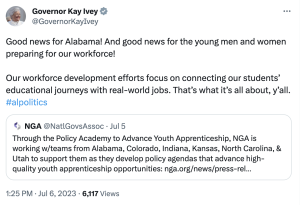 Governor Kay Ivey posted on social media, “Good news for Alabama! And good news for the young men and women preparing for our workforce! Our workforce development efforts focus on connecting our students’ educational journeys with real-world jobs. That’s what it’s all about, y’all.”
“We are especially proud of our Alabama Office of Apprenticeship (AOA). This multi-state opportunity is another example of the AOA’s superior work. The work of the AOA, STEM development, and many other Commerce workforce initiatives demonstrate Secretary Greg Canfield’s commitment to developing the Alabama workforce. These efforts move us closer to meeting Governor Ivey’s Success Plus goals in developing a strong workforce for the very successful economic sectors within the state. I applaud the AOA Team and look forward to the outcomes,” said Ed Castile, Deputy Secretary of Commerce for Workforce Programs.
The Partnership to Advance Youth Apprenticeship (PAYA) – a collaborative initiative led by New America for which the NGA Center has served as national partner since its inception in 2018 – defines youth apprenticeship as a structured, work-based learning program designed to start when apprentices are in high school. PAYA’s definition of youth apprenticeship also includes the following four elements that support high-quality programs and outcomes for students and employers.
“We are always pleased to be a part of the broad workforce initiatives going on in Alabama and immensely appreciative of the support of Governor Ivey. Being chosen to participate in this NGA policy academy gives us a chance to share our successes and learn from our peers around the nation, bringing home and implementing the very best ideas,” said Josh Laney, Director of the AOA.
Tim McCartney, Alabama Workforce Council Chairman said, “The AWC is proud to support this innovative in-school youth apprenticeship policy academy. This project will help us reach disconnected youth, which is a target population for reaching the Success Plus goals.”
Read the National Governors Association full press release:
https://www.nga.org/news/press-releases/6-states-selected-to-participate-in-nga-youth-apprenticeship-policy-academy/
The Alabama Workforce Council conducted the Statewide Survey of Alabama Hourly Employees to identify barriers preventing workers, especially those from Alabama’s 16 special populations, from accessing education, training, or going to work.
The survey was conducted by Cygnal between May 9th and 18th, 2023, and 408 hourly workers responded to the survey. 39% were male and 61% were female. The results of the survey identified an array of barriers for these workers.
The majority of those surveyed identified childcare as a very important factor in their ability to attend work regularly. 52% of parents have missed work because they don’t have childcare. In addition, 38% of working parents drive their kids to school.
Transportation also remains a barrier for hourly workers. Half of workers drive over 30 minutes in their commute, and a third of workers have lost or quit their job due to transportation issues. Nearly 60% of workers have missed work due to their car breaking down, a majority of workers do not have access to public transportation, and 13% of those surveyed reported that they have no other reliable transportation to work.
More than a third of those surveyed reported delaying a new job, taking a new position with the same employer, or entering school or training for fear of losing Supplemental Nutrition Assistance Program (SNAP) benefits. 52% reported a similar course of action for fear of losing Medicaid.
Click on a button below to view the full reports:
BIRMINGHAM, Ala. (Feb.16, 2023) – The Alabama Office of Apprenticeship and FuelAL, a program of the Economic Development Partnership of Alabama (EDPA), are proud to announce partnership in hosting the Second Annual Governor’s Summit on Talent Retention & Work-Based Learning. The Summit will take place in Mobile, Alabama, at the Renaissance Mobile Riverview Plaza Hotel, May 3-5, 2023.
The Summit will bring together employers, educators, economic developers and workforce professionals from across Alabama to learn best practices in talent retention & workforce development. Keynote speakers and panelists representing each sector will share their unique perspectives on how talent retention and work-based learning can benefit each component of a successful economy.
The Summit will also offer various breakout and panel sessions focused on topics such as apprenticeship, career pathways, and other work-based learning resources. Attendees will gain valuable workforce development tools and resources to better equip them.
Alabama Survey of the Alabama Unemployed and Underemployed 4.0
The Governor’s Office of Education and Workforce Transformation and the Alabama Workforce Council conducted the fourth iteration of the Alabama Survey of the Unemployed and Underemployed to measure awareness and attitudes towards new job training programs in Alabama among underemployed and unemployed Alabamians.
The survey was conducted by Cygnal between January 4 and January 16, 2023, and 500 underemployed and unemployed Alabamians responded to the survey. 48% of respondents were male and 52% were female. The results of the Alabama Survey of the Unemployed and Underemployed underscores that fact that COVID-19 as a barrier to employment has almost entirely evaporated, although 45% of respondents claim COVID-19 has contributed to their current state of underemployment or unemployment.
At least three-quarters of respondents are very likely to seek entry to workforce in 2023. The number of men that responded to the survey that have been underemployed longer than 6 months have decreased, while the number of underemployed women has increased. Women are 11% more likely than men to have been underemployed longer than 6 months. Workers over the age of 35 are over 20% more likely to be underemployed for more than 6 months than workers under 35.
The current major obstacle to full employment is now transportation, followed by personal health, and familial obligations. 21% of Alabama jobseekers cited transportation as their greatest barrier to full-time employment, and 31% said it was their primary reason for being either unemployed or underemployed. Lack of transportation is particularly daunting for low-income and urban jobseekers, while older workers are hampered more by health issues. Women are three times more likely than men to cite familial obligations as a barrier to work.
Earning more money has become the preeminent reason for changing industries for both men and women, though women tend to place greater emphasis on reducing stress and a flexible schedule. The top concerns at the height of the pandemic, stability, and consistent wages, have fallen to secondary concerns. High-income earners are more likely to seek out an industry that has a more flexible workload and schedule. 83% of unemployed and underemployed workers are willing to apply for non-remote work, which is up from 77% during the height of pandemic.
When it comes to free training programs, business administration, human services, and information technology garner the most interest. A plurality of respondents said earning a certificate or license is their main goal when receiving job training or education. 41% of respondents said additional training is too expensive. A plurality of unemployed and underemployed workers see value in obtaining a credential before seeking full-time employment. Only 20% respondents completed additional job training while underemployed or unemployed.
At least 85% of respondents said they were more likely to apply for a job after reading about available programs and resources. Men and workers under 35 prefer skills training programs when considering applying for jobs, while women and workers over 35 are more interested in pursuing resources like community college, job fairs, and career coaching.